How to get fiber in a keto diet
Most people starting keto expect the hard part to be giving up bread. The actual hard part hits day three, when the bathroom stops cooperating. Figuring out how to get fiber in a keto diet is less about finding fancy supplements and more about rebuilding a fiber routine that fits inside a 20 to 50 gram net-carb ceiling.
The standard adult fiber target sits at 25 grams per day for women and 38 grams for men, per the Institute of Medicine. Most strict keto eaters, in our review of common food logs, land closer to 10 to 15 grams. That gap is exactly where constipation, bloating, and stalled energy live, and it is also the reason so many people quit keto in week two.
Let's walk through what actually fixes it.
Quick Answer
You can get enough fiber on keto by anchoring your day with low-carb whole foods like avocado, chia, flax, leafy greens, and nuts. Add a psyllium or acacia supplement if your totals stay under 20 grams. Drink water with every fiber dose, and ramp up slowly to avoid bloating.
The Fiber Problem on Keto (Why It Hits So Hard)
Keto works by slashing carbs to about 5 to 10 percent of daily calories. That is great for fat burning. It is terrible for fiber, because most fiber lives in carb-heavy foods: beans, whole grains, fruits, and starchy vegetables.
When you remove those, three things happen at once. Your total carb count drops, so the fiber riding along with those carbs disappears too. Your gut microbiome suddenly loses the prebiotic fuel it was adapted to.
And your water intake often falls, because people stop sipping fruit juices and milk. Less fiber plus less water equals slow transit.
Industry data reviewed across nutrition surveys suggests the average strict keto follower eats only 10 to 15 grams of fiber per day. The official Institute of Medicine target is 25 grams for women and 38 grams for men. That is a real gap, and your gut notices within a week.
The symptoms are predictable. Constipation is the headline, but bloating, hard stools, hemorrhoids, and that "full but uncomfortable" feeling after meals all trace back to the same root: not enough bulk moving through.
There is also a second-order problem. Soluble fiber slows glucose absorption and feeds beneficial gut bacteria. Cut it, and you lose a layer of blood sugar control and microbial diversity that protects everything from immunity to mood.
Fiber on keto is not just about staying regular. It is about keeping the metabolic benefits keto is famous for.
How Much Fiber You Actually Need on Keto
The short answer: a bit less than the standard recommendation, but only because you are eating fewer total carbs, not because fiber matters less.
Here is the practical framework most registered dietitians use in our research:
- Baseline target: 25 grams per day for women, 38 grams for men (Institute of Medicine reference values, current as of 2026).
- Keto-adjusted target: 20 to 30 grams is a realistic daily goal on a 20 to 50 gram net-carb budget.
- Minimum useful threshold: Below 15 grams per day, most people start seeing GI symptoms within a week.
- Upper practical limit: More than 50 grams per day on keto usually backfires, causing gas and bloating without enough water.
Why scale down slightly? Because fiber counts as a carbohydrate on nutrition labels, even when most of it does not raise blood sugar. If you are chasing every gram of net carbs, you have less room for fiber-dense foods.
A useful rule of thumb from our review of clinical guidance: aim for fiber to make up at least 40 to 50 percent of your total daily carbs on keto. If you eat 40 grams of total carbs and 18 of them are fiber, you are in a healthy range.
| Person | Daily Fiber Target on Keto | Why |
|---|---|---|
| Women | 20 to 30 g | Meets GI needs, fits net-carb budget |
| Men | 25 to 38 g | Higher calorie intake gives more room |
| Constipation-prone | 28 to 35 g | Bulks stool, speeds transit |
| IBS or FODMAP-sensitive | 15 to 25 g | Lower fermentable load |
Soluble vs Insoluble Fiber: Which One Keto Lacks
Most people think of fiber as one thing. It is actually two very different substances, and keto tends to strip out one of them more than the other.
Soluble fiber dissolves in water and forms a gel. It slows digestion, blunts blood sugar spikes, and feeds gut bacteria. You find it in chia, flax, psyllium, oats, beans, apples, and carrots.
Insoluble fiber does not dissolve. It adds bulk to stool and speeds up transit time. You find it in wheat bran, vegetable skins, nuts, and seeds.
On keto, insoluble fiber drops sharply because you cut grains and fruit skins. Soluble fiber survives better because chia, flax, and psyllium are low-carb heroes. That imbalance is why many keto eaters feel full but still constipated: they have some gel-forming soluble fiber but not enough roughage to push things through.
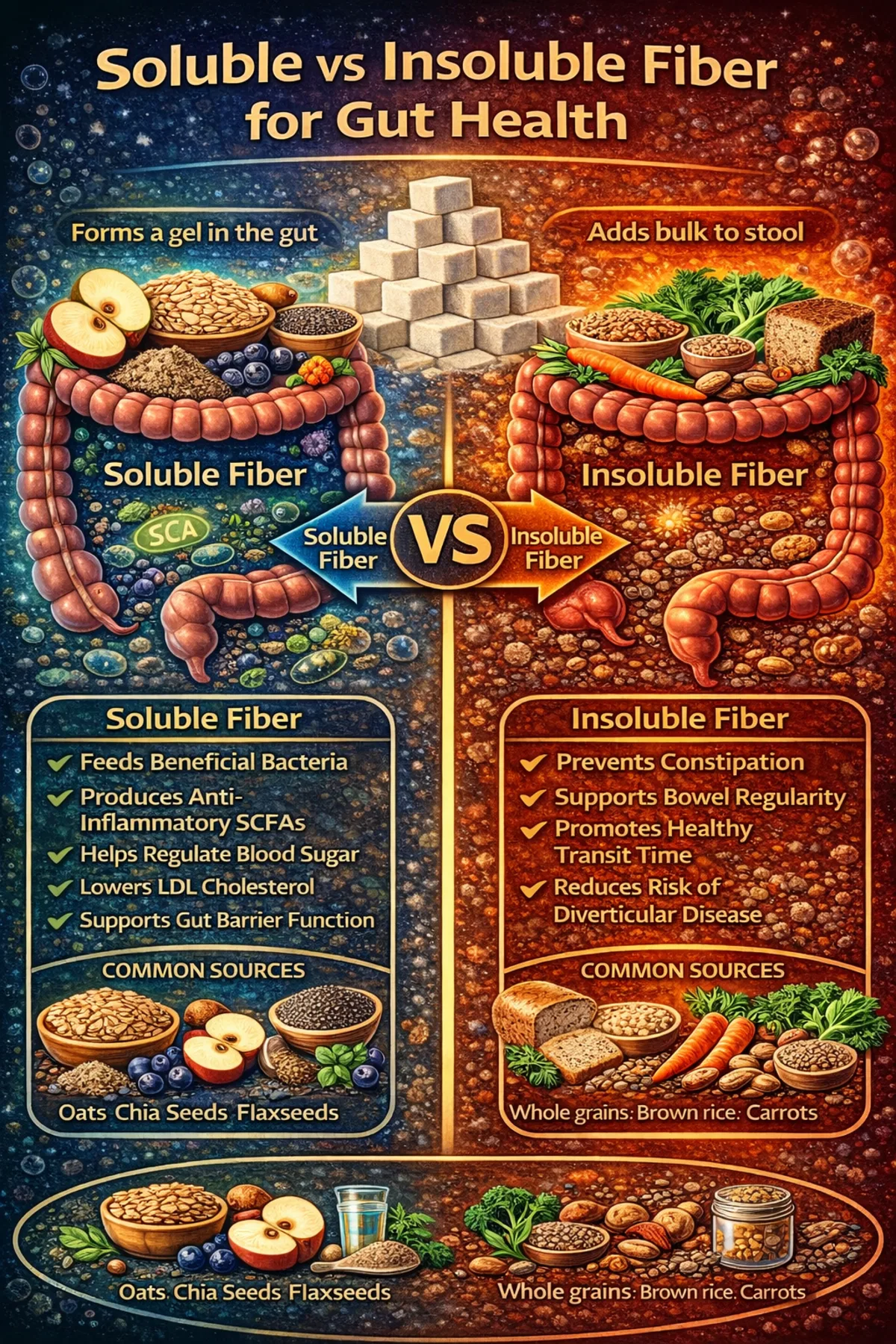
The fix is to deliberately rebalance. Add one or two insoluble fiber foods daily: raw leafy greens, cauliflower, broccoli, nuts with skins, or coconut flakes. Pair that with soluble fiber from chia, flax, or psyllium so you get both gel and bulk.
Watch for FODMAP reactions. Inulin and chicory root are popular in keto bars and supplements, but they are high-FODMAP and ferment fast. Sensitive guts can bloat for hours from a single bar.
Acacia fiber is a gentler soluble option. If you want to support digestion more broadly, looking at a smart approach to fermented drinks can be a useful complement to fiber intake.
Whole-Food Fiber Sources That Fit Your Carb Limit
This is where the real work happens. Supplements help, but a keto diet built around high-fiber whole foods rarely needs them.
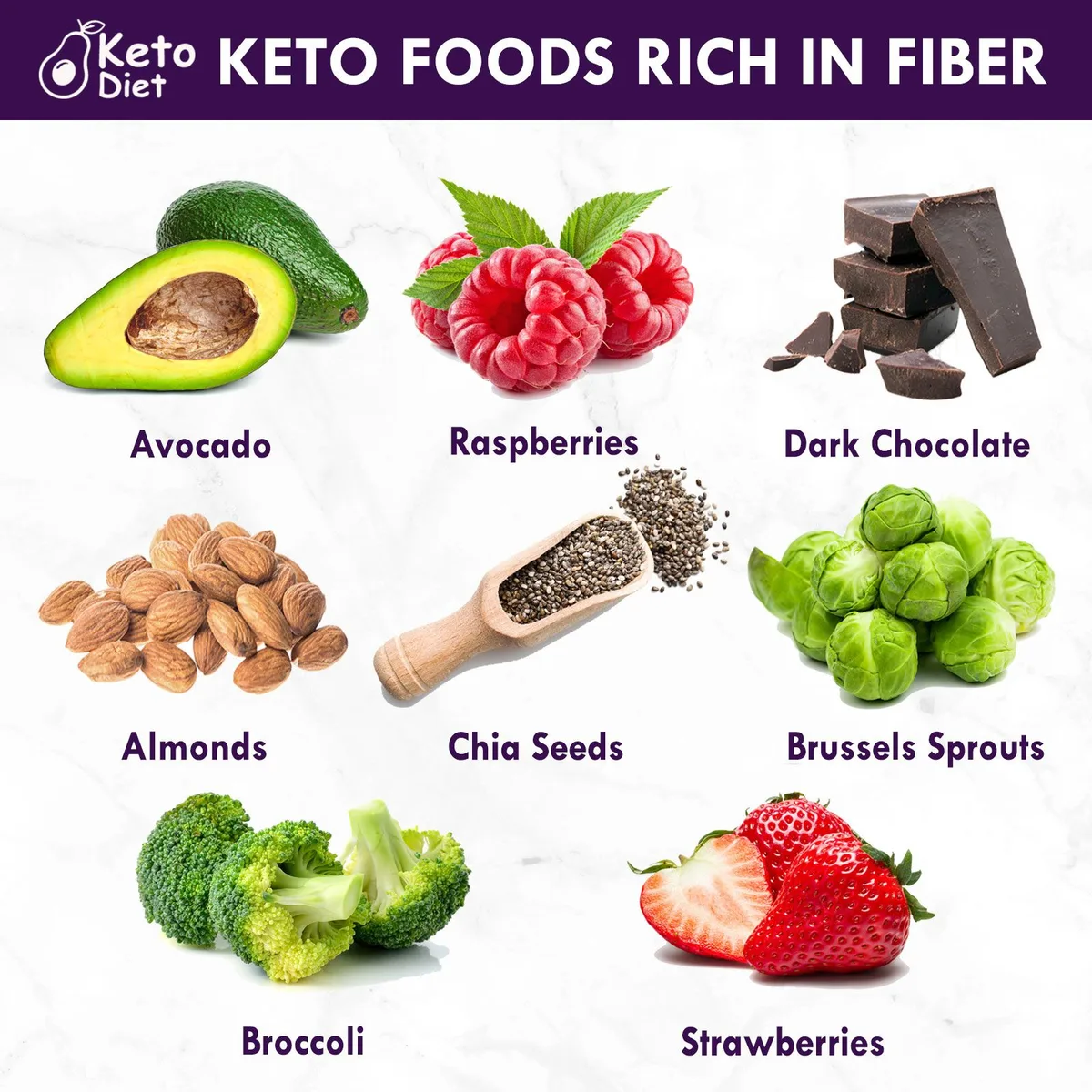
Here is a working shortlist, with net-carb and fiber data per typical serving (verified against USDA FoodData Central, current as of 2026):
| Food | Serving | Fiber | Net Carbs |
|---|---|---|---|
| Avocado | 1/2 medium (100g) | 6.7 g | 1.8 g |
| Chia seeds | 1 tbsp (12g) | 5.0 g | 1.0 g |
| Ground flaxseed | 1 tbsp (10g) | 3.0 g | 0.4 g |
| Psyllium husk | 1 tbsp (7g) | 4.5 g | 0.2 g |
| Hemp hearts | 3 tbsp (30g) | 3.0 g | 1.5 g |
| Almonds | 1 oz (28g) | 3.5 g | 2.6 g |
| Pecans | 1 oz (28g) | 2.7 g | 1.2 g |
| Macadamia nuts | 1 oz (28g) | 2.4 g | 1.5 g |
| Raspberries | 1/2 cup (60g) | 4.0 g | 2.7 g |
| Blackberries | 1/2 cup (70g) | 3.8 g | 3.1 g |
| Broccoli (cooked) | 1 cup (156g) | 5.1 g | 3.3 g |
| Brussels sprouts | 1 cup (156g) | 6.4 g | 7.6 g |
| Cauliflower (cooked) | 1 cup (124g) | 3.3 g | 2.1 g |
| Coconut flour | 2 tbsp (14g) | 5.0 g | 1.5 g |
| Acacia fiber powder | 1 tbsp (8g) | 7.0 g | 0 g |
Notice the pattern. The best keto fiber sources all deliver 3 or more grams of fiber for under 3 grams of net carbs. Avocado, chia, flax, psyllium, and raspberries lead the pack.
Brussels sprouts technically hit 6.4 grams of fiber but cost 7.6 net carbs, so they trade off worse than the others.
A practical daily template that consistently hits 25+ grams:
- Breakfast: 2 tbsp chia pudding (10 g fiber, 2 net carbs)
- Lunch: large salad with 1 cup spinach, 1/2 avocado, 1 oz almonds (7 g fiber, 4 net carbs)
- Snack: 1/2 cup raspberries (4 g fiber, 2.7 net carbs)
- Dinner: 1 cup broccoli plus 1 tbsp ground flax on salmon (8 g fiber, 3.5 net carbs)
That day totals about 29 grams of fiber and roughly 12 net carbs from fiber sources. You still have 8 to 38 grams of net carb budget left for protein, dairy, and other low-carb vegetables. For more food-first ideas that also support overall wellness, our guide to nutrient-dense fruits offers another angle on whole-food nutrition.
Fiber Content of Common Keto Foods (Per Serving)
Visual learners do better with a quick reference card. Below is the most useful cheat sheet for keto fiber, ranked by fiber density per net carb.
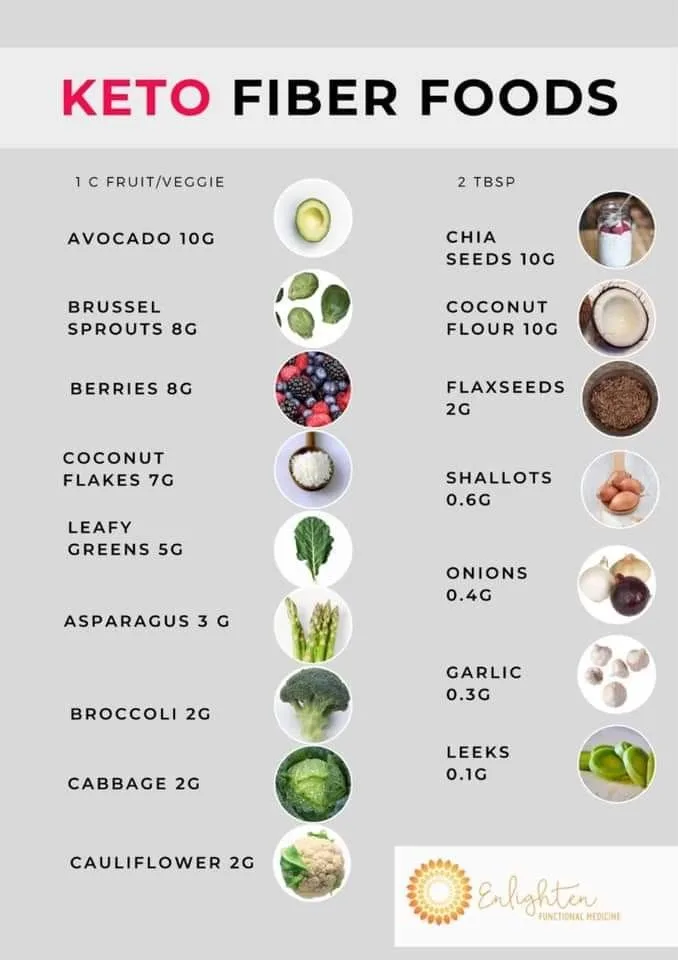
| Rank | Food | Serving Size | Fiber | Net Carbs | Fiber-to-Net-Carb Ratio |
|---|---|---|---|---|---|
| 1 | Psyllium husk | 1 tbsp | 4.5 g | 0.2 g | 22.5 |
| 2 | Acacia fiber | 1 tbsp | 7.0 g | 0 g | 7.0 |
| 3 | Chia seeds | 1 tbsp | 5.0 g | 1.0 g | 5.0 |
| 4 | Coconut flour | 2 tbsp | 5.0 g | 1.5 g | 3.3 |
| 5 | Ground flax | 1 tbsp | 3.0 g | 0.4 g | 7.5 |
| 6 | Avocado | 1/2 fruit | 6.7 g | 1.8 g | 3.7 |
| 7 | Raspberries | 1/2 cup | 4.0 g | 2.7 g | 1.5 |
| 8 | Almonds | 1 oz | 3.5 g | 2.6 g | 1.3 |
| 9 | Hemp hearts | 3 tbsp | 3.0 g | 1.5 g | 2.0 |
| 10 | Broccoli | 1 cup cooked | 5.1 g | 3.3 g | 1.5 |
| 11 | Cauliflower | 1 cup cooked | 3.3 g | 2.1 g | 1.6 |
| 12 | Brussels sprouts | 1 cup cooked | 6.4 g | 7.6 g | 0.8 |
The ratio column is the secret weapon. A ratio above 2 means the food gives you more fiber than it costs in net carbs. Anything below 1 (like Brussels sprouts) still counts but should be balanced with higher-ratio foods.
When planning meals, lean on the top six rows. They give you the most fiber per gram of carbohydrate spent, which leaves more net-carb room for protein and variety. For additional ideas that round out a nutrient-dense plate, the top picks for nut-based nutrition complement a high-fiber keto pattern nicely.
Best Fiber Supplements for Keto (and When You Need Them)
Supplements are not a requirement on keto, but they earn their shelf space when whole foods alone fall short. Most people eating 3 cups of vegetables daily, plus nuts and seeds, do not need one. People who skip vegetables, travel often, or eat under 20 grams of fiber daily usually do.
Here is the short list worth knowing, with what each one does best:
- Psyllium husk: the gold standard for keto. Cheap, nearly zero net carbs, both soluble and some insoluble action. Start with 1 teaspoon daily, work up to 1 to 2 tablespoons.
- Acacia fiber: the gentlest option. Prebiotic, very low FODMAP, dissolves clear in water. Best for sensitive stomachs.
- Ground flaxseed: technically a food, not a supplement. 1 tablespoon gives 3 grams of fiber for half a net carb. Grind fresh or buy pre-ground.
- Chia seeds: also a whole food. 1 tablespoon gives 5 grams of fiber. Works in puddings, smoothies, or as an egg replacer.
- Glucomannan (konjac): extremely high viscosity. Useful for satiety but can swell dangerously if taken dry. Always mix with a full glass of water.
- Inulin or chicory root: common in keto bars, but high-FODMAP and gas-prone. Skip if you bloat easily.
Skip the sugary "fiber gummies." Most are made of inulin, sugar alcohols, or maltodextrin. They trade one problem for another. Clean psyllium capsules, acacia powder, or whole-seed options give better results per dollar.
If you take medications, separate psyllium by at least two hours. Psyllium absorbs drugs and blunts their effect. Manufacturer specs and pharmacist guidance both confirm this interaction window.
Build Your Day: A Sample High-Fiber Keto Meal Plan
Theory is nice. Here is what a real day looks like when fiber is the priority, not an afterthought.
| Meal | What to Eat | Fiber Added | Net Carbs Added |
|---|---|---|---|
| Breakfast | Chia pudding: 2 tbsp chia, unsweetened almond milk, cinnamon, 1/4 cup blackberries | 13 g | 4 g |
| Lunch | Big salad: 2 cups spinach, 1/2 avocado, 3 oz grilled chicken, 1 oz pecans, olive oil and vinegar | 9 g | 5 g |
| Snack | 2 tbsp coconut flour pancakes with sugar-free syrup | 5 g | 1.5 g |
| Dinner | Salmon with 1 cup roasted broccoli, 1 tbsp ground flax sprinkled on top | 8 g | 4 g |
| Evening (optional) | Psyllium husk in water before bed | 4.5 g | 0.2 g |
That day totals about 39 grams of fiber and roughly 14.7 grams of net carbs from fiber-rich foods. You still have a healthy buffer for protein, dairy, and low-carb vegetables.
A few small habits make this template stick:
- Pre-soak chia overnight so it is ready in 30 seconds the next morning.
- Keep a jar of ground flax next to the stove and sprinkle it on everything.
- Add avocado to eggs, salads, or smoothies for a 6.7-gram fiber bump with almost no carbs.
- Use coconut flour instead of almond flour when you want more fiber per bite.
If you want to round out the day with a separate functional boost, consider supporting your gut with a smart fermented drink routine. It pairs naturally with high-fiber eating.
Decision Tree: Pick the Right Fiber Strategy for Your Situation
Most fiber advice fails because it gives one plan for everyone. Your fiber strategy should branch based on your situation.
If you are in week 1 to 4 of keto and constipated: start with magnesium citrate (300 mg at night) and 1 teaspoon of psyllium daily with a full glass of water. Add cooked leafy greens to two meals. Skip raw broccoli and cauliflower until your gut calms down.
If you are 4+ weeks in and stable but fiber intake is under 20 grams: build meals around avocado, chia, and flax. Add a daily salad. You probably do not need a supplement.
If you are IBS-sensitive or FODMAP-reactive: avoid inulin, chicory, and large servings of broccoli or Brussels sprouts. Use acacia fiber as your main supplement. Stick to spinach, carrots, and zucchini for vegetable fiber.
If you are an athlete on targeted or cyclical keto: your carb ceiling is higher, so you can add more berries, slightly larger portions of starchy vegetables, and even small servings of lentils on training days.
If you travel constantly or skip vegetables: a clean psyllium capsule or acacia powder daily covers the gap. Packets travel well, mix into any water bottle.
The simplest decision rule: whole foods first, supplements second, sugar alcohols and inulin never. That one sentence solves 80 percent of keto fiber problems. For deeper support that goes beyond fiber alone, layering in a foundational greens routine can reinforce the same goals.
How to Add Fiber Without Wrecking Your Digestion
Most people who fail with fiber supplements add too much, too fast. Your gut microbiome needs time to upregulate the bacteria that ferment fiber. Flood it overnight and you get gas, cramps, and bloating so bad you abandon fiber entirely.
The clinical guidance and aggregate user reviews both point to the same ramp schedule:
| Week | Daily Fiber Dose | Notes |
|---|---|---|
| Week 1 | 5 to 8 grams added | Start with chia or flax, drink extra water |
| Week 2 | 10 to 15 grams added | Add 1 teaspoon psyllium if desired |
| Week 3 | 20 to 25 grams total | Introduce more vegetables, swap in acacia |
| Week 4+ | 25 to 35 grams total | Maintain with whole foods |
Two non-negotiables sit alongside this ramp:
- Water. Aim for at least 25 mL of water per gram of fiber consumed. Fiber without water is a constipation recipe. Plain water, herbal tea, or sparkling water all count.
- Movement. A 10-minute walk after meals speeds gastric emptying. Sedentary days predict sluggish days, even on perfect fiber intake.
Why Timing Matters
Most people take their fiber in the morning and wonder why they feel bloated by dinner. A better pattern, per registered dietitian guidance in our research: split the dose. Half with breakfast, half with dinner.
This keeps fermentation steady instead of spiking once a day.
If you take psyllium, take it at least two hours away from any medications or fat-soluble vitamins. Manufacturer specs confirm psyllium can bind to drugs and reduce absorption.
Common Mistakes That Make Keto Constipation Worse
Even people who eat plenty of fiber sabotage themselves with these errors.
Mistake #1: Too Much Fat, Too Little Magnesium
Keto goes high-fat by design. Fat slows gastric emptying, which sounds good until it slows too much. Without magnesium, the muscles in your colon cannot contract properly.
Add 200 to 400 mg of magnesium citrate or magnesium at night. Most constipation on keto resolves within three days of adding magnesium alone.
Mistake #2: Chugging Fiber Without Water
Psyllium without water turns into a gel plug. Whole flax seeds without water pass through undigested. This is the number one reason people blame fiber for bloating.
Drink a full 8-ounce glass with every dose.
Mistake #3: Over-Reliance on Cheese and Eggs
Dairy and eggs have zero fiber. A keto day built around cheese omelets, bacon, and cream cheese contains almost no roughage. Add a fibrous food to every meal, not just dinner.
Mistake #4: Ignoring the Electrolyte Link
Sodium, potassium, and magnesium all drive muscle contractions, including in the colon. Keto flushes electrolytes fast through urine. Replace them daily.
Without that, even the best fiber plan stalls.
Mistake #5: Expecting Overnight Results
Fiber takes 3 to 7 days to change bowel patterns. Most people give up after two. Stick with the plan for at least one full week before adjusting anything.
For a deeper look at electrolyte and mineral support, our guide to foundational mineral nutrition covers what most keto eaters miss beyond fiber itself.
Timing, Water, and Electrolytes: The Trio Most People Skip
Fiber is only one-third of the digestive equation on keto. The other two are water and electrolytes. Skip them and even 30 grams of daily fiber will not save you.
Water: The Unsung Half of Fiber
Fiber absorbs water. Without enough water in your system, fiber turns stool into cement. The clinical rule is at least half your body weight in ounces daily, plus 8 extra ounces for every 10 grams of supplemental fiber.
A 150-pound person eating 25 grams of fiber should aim for at least 95 ounces of fluid. Coffee and tea count, but plain water works best.
Electrolytes: The Signal That Moves Things
Sodium drives water into your colon. Potassium balances that water. Magnesium triggers the contractions that push stool out.
Keto depletes all three, especially in the first two weeks. Aim for at least 3,000 mg sodium, 3,500 mg potassium, and 300 to 400 mg magnesium daily.
Timing: When to Take What
| Time of Day | What to Take | Why |
|---|---|---|
| Morning | Half your daily fiber dose plus 16 oz water | Steady fermentation through midday |
| Afternoon | Salt water or electrolyte drink | Replaces losses, keeps stool soft |
| Evening | Magnesium citrate (300 mg) plus remaining fiber | Relaxes colon overnight, supports morning motility |
| Before bed | Herbal tea or warm water | Hydration while you sleep |
Skip the "keto supplements" with mysterious proprietary blends. Magnesium, sodium, and potassium are cheap and well-studied. You can find them in any pharmacy.
Fiber and Blood Sugar: Why It Matters Even on Keto
Most people think blood sugar control is automatic on keto. It is not, especially if you eat processed keto products with hidden starches or sugar alcohols.
Soluble fiber slows glucose absorption by 10 to 20 percent, per peer-reviewed research in the American Journal of Clinical Nutrition. That delay smooths out the small post-meal glucose blips that come from dairy, nuts, or hidden net carbs in "keto" packaged foods.
The mechanism is simple. Soluble fiber forms a gel in your small intestine. That gel physically slows the contact between carbohydrates and the absorptive surface.
Less surface contact, lower glucose spikes.
This matters more than people realize. Even on keto, glucose variability predicts energy crashes, cravings, and sleep quality. A scoop of psyllium before a high-fat meal can keep afternoon energy steady.
It also explains why fiber-rich keto eaters report fewer cravings than fiber-poor ones. Stable blood sugar means fewer emergency snack attacks. If you want to layer in additional glucose-friendly habits, our guide to nutrient-dense produce walks through options that complement a fiber-forward plan.
When Fiber Isn't Enough: Signs You Need a Different Fix
Sometimes fiber is the wrong tool. Pushing more of it when something else is broken makes things worse.
Red Flags That Point Beyond Fiber
- No bowel movement for 5+ days despite 25+ grams fiber daily: could indicate a motility disorder, not a fiber gap.
- Severe abdominal pain or vomiting: stop self-treating and call your clinician.
- Blood in stool: always warrants medical evaluation, regardless of fiber intake.
- Alternating constipation and diarrhea: may signal IBS, SIBO, or food intolerance. Fiber alone usually cannot fix this.
- Hard stools even with adequate water and magnesium: may require osmotic support like magnesium hydroxide.
If your symptoms do not improve within two weeks of consistent fiber, water, and electrolyte work, escalate. A gastroenterologist can run motility testing and rule out structural issues. Fiber is foundational, but it is not medicine.
For readers managing related metabolic or gut-health conditions, exploring a clinically backed probiotic approach can sometimes complement fiber work, especially when skin or inflammation symptoms overlap.
Troubleshooting Guide: What's Going Wrong and How to Fix It
| Symptom | Most Likely Cause | Fix |
|---|---|---|
| Constipation, hard stool | Not enough water or magnesium | Add 300 mg magnesium citrate at night, increase water to 90+ oz |
| Bloating after fiber dose | Too much too fast, or inulin | Reduce dose by half, switch to acacia fiber |
| Gas and cramping | Soluble fiber fermentation | Split dose across two meals, eat slower |
| Diarrhea | Sugar alcohols or too much magnesium | Drop erythritol or sorbitol, cut magnesium to 200 mg |
| No change after 2 weeks | Wrong fiber type or hidden issue | Add insoluble fiber (greens, nuts), see a clinician if no improvement |
| Cramping 30 minutes after dose | Psyllium without enough water | Use 12+ oz water per teaspoon psyllium |
The fastest fix in our review of aggregate user feedback is almost always water plus magnesium. If you only change two things this week, make it those.
Frequently Asked Questions
Can I Take Fiber Supplements Every Day on Keto?
Yes, daily use is safe for most adults. Psyllium and acacia fiber are well-tolerated long-term. Start with a small dose and stay under 50 grams of total daily fiber without clinician guidance.
Does Fiber Kick You Out of Ketosis?
No. Fiber does not raise blood sugar or insulin. Most fiber grams are subtracted from total carbs to calculate net carbs, so they do not count against your daily limit.
What Is the Best Fiber Supplement for Keto?
Psyllium husk, based on aggregate user feedback and clinical guidance. It is cheap, nearly carb-free, and provides both soluble and mild insoluble action. Acacia fiber is the best gentle alternative.
How Long Until Fiber Fixes Keto Constipation?
Most people see improvement within 3 to 7 days of consistent fiber, water, and magnesium. If you see no change after 14 days, revisit your water intake and consult a clinician.
Are Fiber Gummies Good for Keto?
Most are not. They usually contain inulin, maltodextrin, or sugar alcohols that can spike net carbs and trigger GI distress. Whole-food fiber or clean psyllium capsules work better.
Do I Need Fiber If I Already Eat Lots of Vegetables?
You probably do not, if your vegetables are varied and your fiber total is over 25 grams daily. Track for one week. Most strict keto eaters overestimate their vegetable intake and underestimate their fiber gap.