How to make a raw diet for dogs: Easy Guide
Learning how to make a raw diet for dogs the right way is mostly about three things: hitting the nutrient ratios, choosing safe bones, and keeping your kitchen clean. Most problems owners hit (loose stool, fractured teeth, calcium deficiency) come from skipping the math or winging the sourcing.
The most widely cited target is the BARF or prey-model ratio of 80% muscle meat, 10% raw edible bone, 5% liver, and 5% other organ meats, with adult dogs eating roughly 2 to 3% of their body weight per day. As of 2026, the AVMA still discourages raw feeding in homes with immunocompromised people, while the FDA and CDC continue to flag Salmonella and Listeria risk in raw pet food. Let's walk through what that actually means for you and your dog.
Quick Answer
To make a raw diet for dogs, combine 80% muscle meat, 10% raw edible bone, 5% liver, and 5% other organs by weight. Feed adults about 2 to 3% of their ideal body weight daily. Source USDA-inspected meat, freeze portions, and thaw in the fridge.
Is a Raw Diet Safe for Dogs? What Vets and Evidence Actually Say
Here's the honest, research-based version. The American Veterinary Medical Association (AVMA) policy discourages feeding raw meat to pets because of pathogen risk to the animal and the household. The FDA and CDC echo this, citing documented Salmonella and Listeria outbreaks linked to raw pet food.
That said, peer-reviewed research and aggregate clinical experience show that a balanced raw diet can produce visible benefits. Studies published in the Journal of Animal Physiology and Animal Nutrition and similar outlets report improvements in coat gloss, stool quality, and dental scores in dogs fed raw meaty bones compared to dry kibble.
The risk picture looks like this:
- Pathogens: raw meat can carry Salmonella, E. coli, Listeria, and Campylobacter. These can infect the dog and shed into the home.
- Nutritional imbalance: homemade raw diets that skip bone or organ meat cause calcium deficiency, vitamin A toxicity, or taurine depletion.
- Physical hazards: cooked bones fracture teeth. Weight-bearing bones of large mammals (femur, knuckle) can chip molars.
- Household risk: immunocompromised people, pregnant women, and infants should not handle raw pet food.
A raw diet is safe for dogs only when the math, the sourcing, and the hygiene are right. Skipping any of those creates the problems critics warn about.
What a Complete Raw Dog Food Diet Looks Like (80/10/10 and Prey Model Explained)
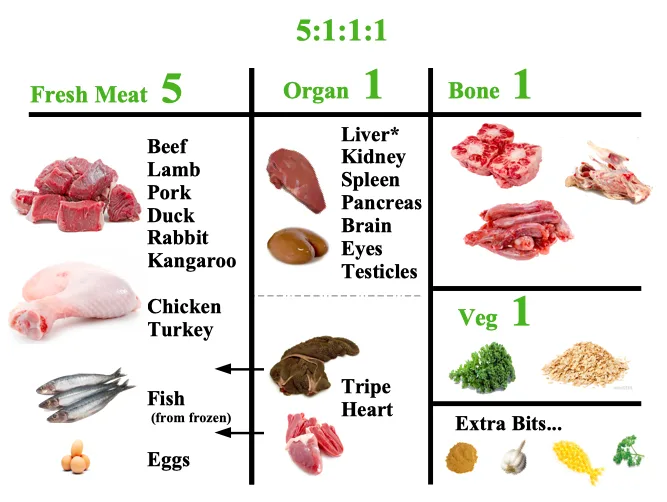
The most common framework is called 80/10/10, also called the prey-model raw ratio. It breaks a meal into four parts by weight, not by volume.
| Component | Percentage | Examples |
|---|---|---|
| Muscle meat | 80% | Chicken thigh, beef chuck, turkey breast |
| Raw edible bone | 10% | Chicken necks, chicken backs, turkey necks |
| Liver | 5% | Beef liver, chicken liver |
| Other organs | 5% | Kidney, spleen, brain, pancreas, testes |
A few things trip people up. First, the 10% bone is non-negotiable. Without it, your dog ends up with a calcium-to-phosphorus ratio way off the AAFCO and NRC target of roughly 1.2:1 to 1.4:1.
Long term, that drives metabolic bone disease.
Second, liver and other organs are not interchangeable. Liver is rich in vitamin A. Feed too much and you risk hypervitaminosis A.
Feed none and you trigger deficiencies in copper, vitamin A, and folate. The 5/5 split keeps both in range.
Third, "muscle meat" includes heart. Heart is technically muscle, and it's one of the densest natural sources of taurine. Taurine matters because taurine-deficient dilated cardiomyopathy (DCM) has been documented in dogs fed unbalanced homemade diets.
The prey-model version is similar but stricter. It mimics a whole prey animal, so it leans heavier on bone (around 12%) and adds glandular tissue like pancreas and brain. Either model works if you keep the ratios and rotate proteins.
If you're managing a dog's allergies or IBD, rotating proteins (chicken one week, beef the next, rabbit after that) lowers the chance of developing a new sensitivity. We talk more about that in our breakdown of best dry dog food for dental health, where protein rotation matters too.
The Building Blocks: Muscle Meat, Raw Bone, Liver, and Other Organs
Let's go ingredient by ingredient. This is where the rubber meets the road on a balanced raw diet.
Muscle Meat (80%)
This is the bulk of every meal. Chicken thigh, turkey, beef chuck, pork shoulder, lamb shoulder, venison, and rabbit all work. Heart should be included at least once a week because of its taurine density.
Avoid fatty trimmings as the main protein. A diet that's mostly fat and very little meat sets dogs up for pancreatitis. Trim visible fat on pork and lamb.
Raw Edible Bone (10%)
Raw bone is your calcium source. It's also what keeps teeth clean and stools firm. Safe options include:
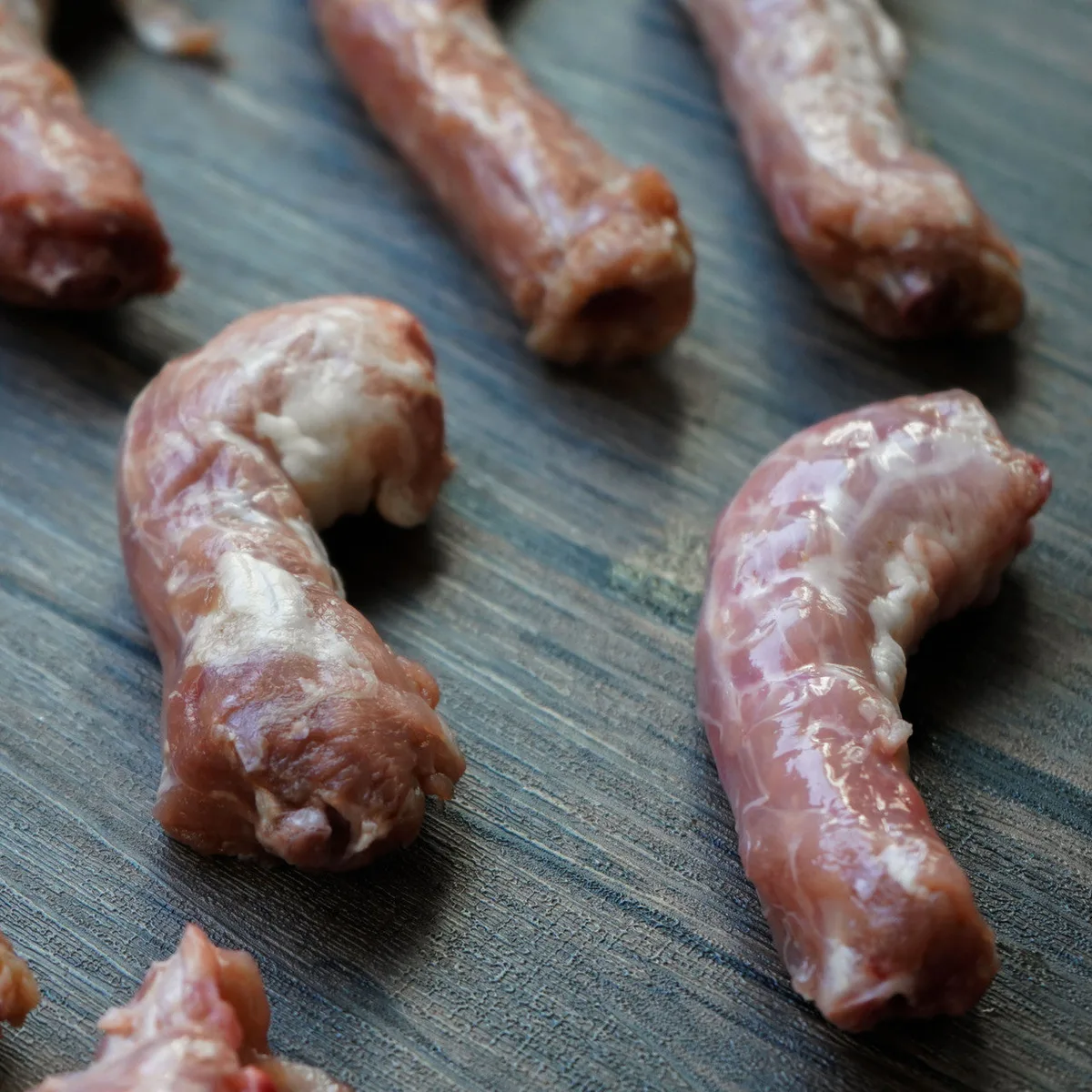
- Chicken necks and backs
- Turkey necks (whole, not halved lengthwise)
- Duck frames
- Quail (whole)
- Rabbit ribs
Skip cooked bones of any kind. Skip weight-bearing bones from large mammals (beef femur, bison shank). Those are too dense for dogs to crush without cracking a tooth.
Liver (5%)
Liver carries vitamin A, copper, B vitamins, and iron. Beef liver, chicken liver, pork liver, and lamb liver all work. Rotate sources weekly to spread trace nutrient exposure.
If your dog turns up his nose at liver, lightly sear the outside. Don't cook it through. You can also blend raw liver into a small amount of warm water or bone broth to mask the taste.
Other Organ Meats (5%)
This bucket is for kidney, spleen, brain, pancreas, testes, and thymus. Each carries a different nutrient profile.
- Kidney: copper, B12
- Spleen: iron
- pancreas: digestive enzymes
- brain: DHA, phospholipids
- testes/thymus: trace hormones and immune factors
If sourcing pancreas or testes is hard where you live, prioritize kidney and spleen. They cover most of what's missing from liver.
How Much to Feed: Daily Ratios by Weight, Age, and Activity Level
Feeding too little starves the dog of nutrients. Feeding too much causes obesity and loose stool. Here's how to hit the target.
Adult Dogs
Feed 2 to 3% of ideal adult body weight per day. Active working dogs may need 3 to 5%. Senior or low-activity dogs often do better at 1.5 to 2%.
Example: a 50-pound adult Border Collie at 2.5% eats about 1.25 pounds of raw food per day. Split into two meals, that's roughly 10 ounces per meal.
Puppies
Puppies need 5 to 10% of their current body weight per day because they're growing fast. Weaned puppies do well on 5 to 6%. By six months, most drop to 3 to 4%.
Puppy meals should be split into four daily feedings until 16 weeks, then three until six months. Ground bone is safer than whole bone for puppies under 20 weeks because their jaws aren't strong enough to crush chicken necks cleanly.
Pregnant and Nursing Females
Lactating bitches often need 4 to 6% of body weight, sometimes more. Pregnancy itself only needs a slight bump in the last three weeks (about 3 to 4%).
Seniors
Senior dogs often need fewer calories but more joint support. Keep the ratio the same, but trim portion size by 10 to 20% and add omega-3-rich fish like sardines twice a week.
Quick Daily Feeding Reference
| Dog Type | % of Body Weight | Meals/Day |
|---|---|---|
| Adult, normal activity | 2 to 3% | 2 |
| Adult, working/sport | 3 to 5% | 2 to 3 |
| Senior, low activity | 1.5 to 2% | 2 |
| Puppy (weaning to 6 mo) | 5 to 10% | 3 to 4 |
| Pregnant (last 3 weeks) | 3 to 4% | 2 |
| Lactating | 4 to 6% | 3 to 4 |
Adjust every two weeks based on body condition. You should feel ribs easily under a thin layer of fat, and the dog should have a visible waist when viewed from above.
If your dog is overweight and you're transitioning off kibble, you'll find more on switching routines in our guide to the best dry dog food for dental health, where calorie control follows similar logic.
Sourcing Meat That Won't Make Your Dog Sick (or Your Family)
Sourcing is where most raw feeders either win or lose. Bad meat defeats the entire purpose.
Choose USDA-Inspected Meat
Any raw meat you feed your dog should be USDA (or equivalent state) inspected. That means it passed through a federally regulated facility. Look for the inspection mark on packaging.
State-by-state inspection marks vary, but USDA-inspected plants are the gold standard.
Prefer Human-Grade When Possible
"Human-grade" means the meat was processed in a facility that also handles food for people. "Feed-grade" meat can legally include material that's not fit for human consumption. For dogs eating raw, human-grade or USDA-inspected pet meat is safer.
Where to Buy
- Local butcher shops: ask for "bone-in" cuts and trim. Many will sell chicken backs, necks, and organ trim cheap.
- Raw pet food co-ops: subscribe to a co-op or local raw supplier. Most ship frozen.
- Online raw pet food brands: companies like Primal, Stella & Chewy's, and Smallbatch ship frozen, complete raw diets. They're convenient and consistent.
- Direct from farms: pasture-raised poultry, grass-fed beef, and heritage pork often come direct from small farms. Confirm inspection status before buying.
What to Avoid
- Roadkill or hunted game without inspection (legal in some areas but risky for pathogens)
- Meat past its sell-by date (pathogen load spikes over time)
- Restaurant kitchen trim (often cooked or partially cooked)
- Pet food labeled "feed-grade" for the bulk of the diet
Rotation matters for sourcing, too. Beef, chicken, turkey, pork, lamb, fish, and rabbit each carry slightly different fatty acid profiles. Rotating across two or three proteins weekly reduces allergy risk and balances trace nutrients.
Step-by-Step: Building a Week of Raw Meals at Home
Plan the week before you shop. It saves money and prevents the "what do I feed tonight?" scramble.
Start by picking two or three proteins. Chicken and beef are easiest to source. Add a third like turkey or pork for variety.
Pick one day to batch-prep the week's portions.
Here's a simple workflow that works for most households:
- Buy in bulk. Order 10 to 20 pounds of chicken, 5 pounds of beef, and the organs you need.
- Portion into daily meals. Use a kitchen scale and weigh out each meal based on the 2 to 3% body weight rule.
- Bag and label. Each daily portion goes in a labeled freezer bag with the date and protein type.
- Stack in the freezer using FIFO. Newest goes in back, oldest up front.
- Pull tomorrow's portion tonight. Move it from freezer to fridge to thaw slowly.
- Add organs last. Keep liver and kidneys in a small weekly jar in the fridge so you're not digging through the freezer three times a day.
- Serve at room temperature. Cold raw straight from the fridge can upset some dogs. Let it sit out 10 minutes before feeding.
A sample 7-day rotation might look like this: chicken and chicken liver Monday, beef and beef kidney Tuesday, chicken and beef spleen Wednesday, turkey and turkey liver Thursday, beef and pork kidney Friday, fish and chicken liver Saturday, beef and beef liver Sunday.
Transitioning a Dog From Kibble to Raw Without Digestive Blowback
A slow switch protects the gut microbiome. Going cold turkey (literally and figuratively) often triggers diarrhea or refusal.
Day 1 to 3: 75% Kibble, 25% Raw
Mix in a small portion of raw alongside the regular kibble. Keep meals separate, but feed them at the same time. Watch stool consistency.
Day 4 to 7: 50/50
Split each meal evenly. The dog's gut enzymes have started adapting to the new protein load. Loose stool at this stage usually means you're going too fast, or the bone content is too high.
Day 8 to 14: 25% Kibble, 75% Raw
By now the dog should be producing firmer, smaller stools, a classic sign raw is working. Maintain 25% kibble only if the dog has a sensitive stomach.
Day 15 Onward: 100% Raw
Once stools are firm and consistent, drop the kibble. Continue rotating proteins weekly.
If your dog refuses raw at any stage, try a different protein. Many kibble-fed dogs reject beef the first week because they're used to chicken-flavored extruded food. Sardines or rabbit often break the resistance.
Don't add kibble back just to coax eating. Let the dog get hungry. Skip one meal before trying again.
Sensitive-stomach dogs do better on ground raw rather than chunks during the transition. Less work for the gut, easier to digest.
Common Mistakes That Cause Calcium Deficiency, Pancreatitis, and Worse
Most raw-diet disasters come from the same handful of errors.
Skipping Bone or Replacing It with Eggshell
Bone is the easiest way to hit the calcium ratio. Some owners try to substitute with eggshell powder or calcium carbonate. Both work, but dosing is precise.
Too little and you get rickets-like bone disease. Too much and you create hypercalcemia. Whole raw bone is self-limiting.
Dogs stop chewing when full.
Overfeeding Liver
Liver is nutrient-dense. Feed more than 5% and vitamin A toxicity develops. Symptoms include bone pain, stiffness, dry skin, and appetite loss.
Stick to 5%.
Feeding Cooked Bones
Cooked bone splinters. It can perforate the gut or obstruct the bowel. Never feed cooked rib bones, cooked chicken bones, or any bone that's been through heat.
Letting the Dog Gorge on Fat Trimmings
A 70-pound Labrador eating a pound of pork fat in one sitting can develop acute pancreatitis. This is an emergency. Trim fat on fatty proteins and feed hearts and lean muscle for the bulk of meals.
No Rotation, Single Protein Forever
Long-term single-protein feeding raises allergy risk and trace nutrient gaps. Rotate across at least three proteins weekly.
Skipping Hygiene
Raw meat on your kitchen counter is a Salmonella vector. Disinfect surfaces, wash hands, and clean bowls after every meal. The FDA's raw pet food guidance is the bare minimum.
Treat raw dog food like raw chicken for human use.
Bones Done Right: Which Bones Are Safe, Which Cause Fractured Teeth
Bone choice is the single biggest physical safety issue with raw feeding.
Safe Raw Bones
- Chicken necks and backs
- Turkey necks (whole)
- Duck frames
- Quail (whole)
- Rabbit ribs
- Goat or lamb necks (small dogs only)
- Soft beef rib bones for giant breeds
Bones to Avoid
- Cooked bones of any kind
- Weight-bearing bones from large mammals: beef femur, bison shank, pork leg
- Cut bones with sharp edges
- Bones too small to chew (can be swallowed whole and choke)
Why Some Bones Crack Teeth
Weight-bearing bones are dense. When a dog crunches down, the force travels up through the tooth root. The enamel chips or the tooth fractures vertically.
Vertical fractures usually require extraction. Always pick bones that the dog can crush with their back molars without much force.
Supplements Most Raw-Fed Dogs Actually Need (and Which Are Optional)
A balanced 80/10/10 diet covers most nutrients. But three supplements come up consistently.
Fish Oil (Almost Always Needed)
Omega-3 from fish oil reduces inflammation and supports coat and joint health. Most raw diets are high in omega-6 because of beef, pork, and poultry. Wild-caught sardines, salmon oil, or krill oil add omega-3.
Dose: about 10 IU vitamin E per pound of body weight daily. Use a vitamin E capsule with fish oil to keep the antioxidant ratio in balance.
Kelp or Seaweed (Often Needed)
Iodine is missing from most inland meat sources. Kelp powder delivers iodine plus trace minerals.
Dose: roughly 0.5 to 1.0 mg iodine per kg of dry matter food. Check the kelp label and weigh out accordingly.
Taurine (Insurance)
Dogs synthesize taurine from cysteine, but some breeds (Golden Retrievers, Cocker Spaniels, Newfoundlands) are prone to taurine-deficient DCM. Adding 250 to 500 mg per day for medium dogs is cheap insurance.
Optional
- Probiotics: useful during transition, optional long-term
- Vitamin E: take it if you're adding fish oil, otherwise skip
- Green-lipped mussel: joint support for seniors
What you don't need: calcium powder (if you feed bone correctly), multivitamins (the diet covers most), or glucosamine (unless prescribed for joint disease).
Special Cases: Puppies, Seniors, Working Dogs, and Dogs With Health Issues
Standard 80/10/10 isn't always the right answer.
Puppies
Puppies need higher fat and slightly higher bone. Many breeders use a 75/15/5/5 ratio for growing dogs. Add a small amount of egg yolk (raw, organic) two to three times a week for choline.
Avoid whole bones for puppies under 16 weeks. Use ground bone mixed into meals.
Seniors
Older dogs often have kidney disease. Raw diets can still work, but phosphorus needs to come down. The fix is leaner muscle meat, slightly less bone, and more omega-3.
Always run bloodwork before adjusting a senior's raw diet.
Working and Sport Dogs
Sled dogs, agility dogs, and hunt-test dogs burn serious calories. Bump up to 3 to 5% of body weight per day, lean toward fattier proteins, and consider adding free-choice bone for recovery days.
Dogs With Chronic Disease
- Kidney disease: lower phosphorus, lower protein. Adjustments need a vet's eye.
- Cancer: high-fat, moderate-protein diets like the Ketogenic raw approach have early research behind them, but they're not for beginners.
- Pancreatitis-prone dogs: keep fat under 10% of total calories. Trim visible fat ruthlessly.
- Allergies: rotation and novel proteins help. Many kibble-allergic dogs do well on rabbit or venison.
If your dog has any chronic condition, work with a veterinary nutritionist before going raw. Your regular vet can handle this. For deeper, condition-specific nutrition choices like urinary tract support, our breakdown of best cat food for urinary tract health covers the principles that apply across species, even if the protein sources differ.
Raw Diet vs Kibble vs Cooked Homemade: An Honest Comparison
No option is perfect. Each has tradeoffs.
| Factor | Raw | Kibble | Cooked Homemade |
|---|---|---|---|
| Convenience | Low to medium | High | Low |
| Cost | Medium to high | Low to medium | Medium |
| Pathogen risk | Higher | Low | Low |
| Dental benefit | High (raw bone) | Low to medium | Low |
| Stool quality | Small, firm | Variable | Variable |
| Nutrient precision | Variable | High (AAFCO) | Variable |
| Time commitment | High | Low | High |
| Travel/boarding | Hard | Easy | Medium |
Kibble wins on convenience and consistency. Raw wins on dental and stool quality. Cooked homemade splits the difference but loses some of the enzyme and microbiome benefits raw advocates cite.
If you decide kibble is a better fit, look at our guide to best dry dog food for dental health for kibble choices that mimic some raw benefits.
Cost Breakdown: How Much You'll Actually Spend Feeding Raw
Raw feeding isn't cheap. But it's also not the bank-breaker many people expect.
A 50-pound dog eating 2.5% of body weight daily needs about 36 pounds of food per month. Here's the typical price spread as of 2026 in the US:
| Source | Cost per pound | Monthly cost (50 lb dog) |
|---|---|---|
| Commercial raw (frozen, complete) | $3.50 to $5.50 | $126 to $198 |
| Raw co-op bulk buy | $2.50 to $3.50 | $90 to $126 |
| Homemade from butcher | $1.50 to $3.00 | $54 to $108 |
| Premium kibble (top-tier) | $2.00 to $3.50 | $72 to $126 |
The biggest variables are sourcing organ meat cheap and buying in bulk. Many raw feeders save 20 to 30% by buying organ trim directly from a local butcher.
For multi-dog homes, the math gets more favorable because you can buy whole cases of meat and split.
Safe Handling, Storage, and Thawing to Avoid Salmonella and Listeria
Raw dog food is one of the highest-risk items in a kitchen for cross-contamination. The pathogen risk to humans is real. The CDC has documented human Salmonella infections traced back to raw pet food in multiple outbreaks.
Follow these rules:
- Use a dedicated cutting board, knife, and bowls for raw dog food.
- Disinfect counters with a dilute bleach solution or hot soapy water after every prep session.
- Wash hands for 20 seconds after handling.
- Store raw dog food below ready-to-eat human food in the fridge.
- Thaw in the refrigerator, not on the counter. Counter thaw enters the 40 to 140°F danger zone within hours.
- Use thawed portions within 48 hours.
- Throw away uneaten food within 30 to 60 minutes. Raw meat sitting out grows bacteria fast.
Families with immunocompromised members, infants, or pregnant women should reconsider raw feeding entirely. The AVMA position is unchanged on this point for good reason.
When to Call the Vet: Warning Signs That Something Has Gone Wrong
Most raw-fed dogs do well. When they don't, the signs are usually fast and obvious.
Call your vet quickly if you see any of these:
- Refusing food for more than 24 hours
- Repeated vomiting
- Bloody stool or black tarry stool
- Sudden lethargy or weakness
- Yellowing of gums or eyes (jaundice)
- Limping, joint pain, or reluctance to move (could be hypervitaminosis A or calcium issues)
- Seizures (possible sodium imbalance from frozen food fed too cold)
If you suspect a pathogen, keep a sample of the last meal in the freezer. Your vet or local public health lab can test it.
Twice-yearly bloodwork is also smart. Run a complete blood count, chemistry panel, and taurine level. This catches gradual drift in calcium, phosphorus, vitamin D, and kidney values before symptoms appear.
Long-Term Success With a Raw Dog Diet: Maintenance and Monitoring
Once your dog is steady on raw, the work shifts to consistency. Weigh the dog every month for the first six months, then quarterly. Body condition changes slowly, and a 1-pound shift on a 30-pound dog matters more than you'd think.
Keep a simple log for the first year. Track protein source, bone ratio, stool quality (1 to 5 scale), skin and coat notes, and any treats or extras. Patterns show up fast when you write them down.
Recheck bloodwork every six months. Calcium, phosphorus, albumin, BUN, ALT, and taurine give you the early signal that ratios are drifting. Your vet can flag trends before they become disease.
Budget your time. Most raw feeders spend 2 to 3 hours per week on prep after the first month. Batch-portion once a week, freeze, and rotate.
Choosing Between Homemade Raw and Commercial Raw
Homemade raw costs less per pound but demands more time and tracking. Commercial raw is more expensive but portioned, pre-balanced, and frozen.
| Factor | Homemade Raw | Commercial Raw |
|---|---|---|
| Time per week | 2 to 3 hours | 30 minutes |
| Cost per pound | $1.50 to $3.00 | $3.50 to $5.50 |
| Nutrient precision | Your job | Manufacturer's job |
| Customization for health issues | High | Limited |
| Sourcing transparency | Your call | Brand dependent |
If you want the dental and coat benefits of raw but not the prep, a commercial complete raw like those from Primal, Stella & Chewy's, or Smallbatch is a fair trade. If budget matters and you want full control, homemade raw works as long as you track ratios. For related sourcing decisions on a tighter budget, our guide to best dry dog food for dental health covers kibble options that complement a partial-raw approach.
Regional Sourcing and Seasonal Availability
Where you live shapes what proteins you can get cheaply. Rural areas often have direct access to venison, rabbit, and grass-fed beef through local ranches. Urban feeders rely on butcher shops and online raw suppliers.
In hunting season (fall through early winter in most of the US), whole deer, elk, and rabbit become available through friends or processors. Wild game must be inspected before feeding if you want pathogen control. Many state wildlife agencies publish inspection guidelines.
Climate matters. Hotter regions see faster bacterial growth on transport, so cold-chain delivery matters more. In the Southwest and Southeast, summer shipments need extra insulation.
Northern regions can store raw in chest freezers year-round with no issues.
If you're sourcing fish, regional rules vary. Coastal states often have direct access to whole sardines and mackerel. Inland feeders use frozen-at-sea fish from online retailers.
Always freeze wild fish at -4°F for 7 days before feeding to kill parasites.
Travel, Boarding, and Daily Life With a Raw-Fed Dog
Raw feeding gets tricky when life moves. Boarding facilities often won't accept raw-fed dogs because of liability and storage concerns. Hotels and rentals don't usually have freezer space.
Plan ahead. Pack a cooler with enough raw meals for the trip plus one extra day. Some owners pre-measure a few days of freeze-dried raw as a backup.
Freeze-dried raw isn't identical to frozen raw, but it keeps the gut on the same diet.
For boarding, call ahead. Some raw-friendly kennels exist in most metro areas. They often charge a small premium for separate freezer space.
If none are available, switch the dog back to kibble for the boarding stay and transition again at home.
Travel days also matter. Never leave raw food unrefrigerated for more than 4 hours total, including serving time. On long drives, keep meals in a cooler with ice packs and feed quickly.
Quick Troubleshooting Guide for Common Raw-Feeding Problems
Most issues show up in the first 30 days. Here's how to read the signals.
| Symptom | Likely Cause | Fix |
|---|---|---|
| Loose stool | Too much bone or sudden transition | Reduce bone to 8%, slow transition |
| Mucus in stool | Cold food fed too cold | Warm to room temp before serving |
| White, chalky stool | Too much bone | Drop to 8 to 9% bone |
| Yellow stool | Too much liver or fat | Cut liver to 3%, trim fat |
| Refusing meals | Single-protein fatigue | Rotate protein, skip one meal |
| Vomiting bile | Hungry between meals | Split into 3 feedings |
If symptoms persist past 5 days, see your vet. Acute pancreatitis and obstruction look similar to simple GI upset early on.
Sample 7-Day Raw Meal Plan for a 50-Pound Dog
This assumes 1.25 lb of food per day, split into two meals.
| Day | Morning (10 oz) | Evening (10 oz) |
|---|---|---|
| Mon | Chicken thigh + chicken liver (0.6 oz |